AI that holds up on your real data
Most AI projects demo well and fall over in production. The difference is almost never the model — it's retrieval, evaluation, permissions and what happens when the system doesn't know. That's the part we build.
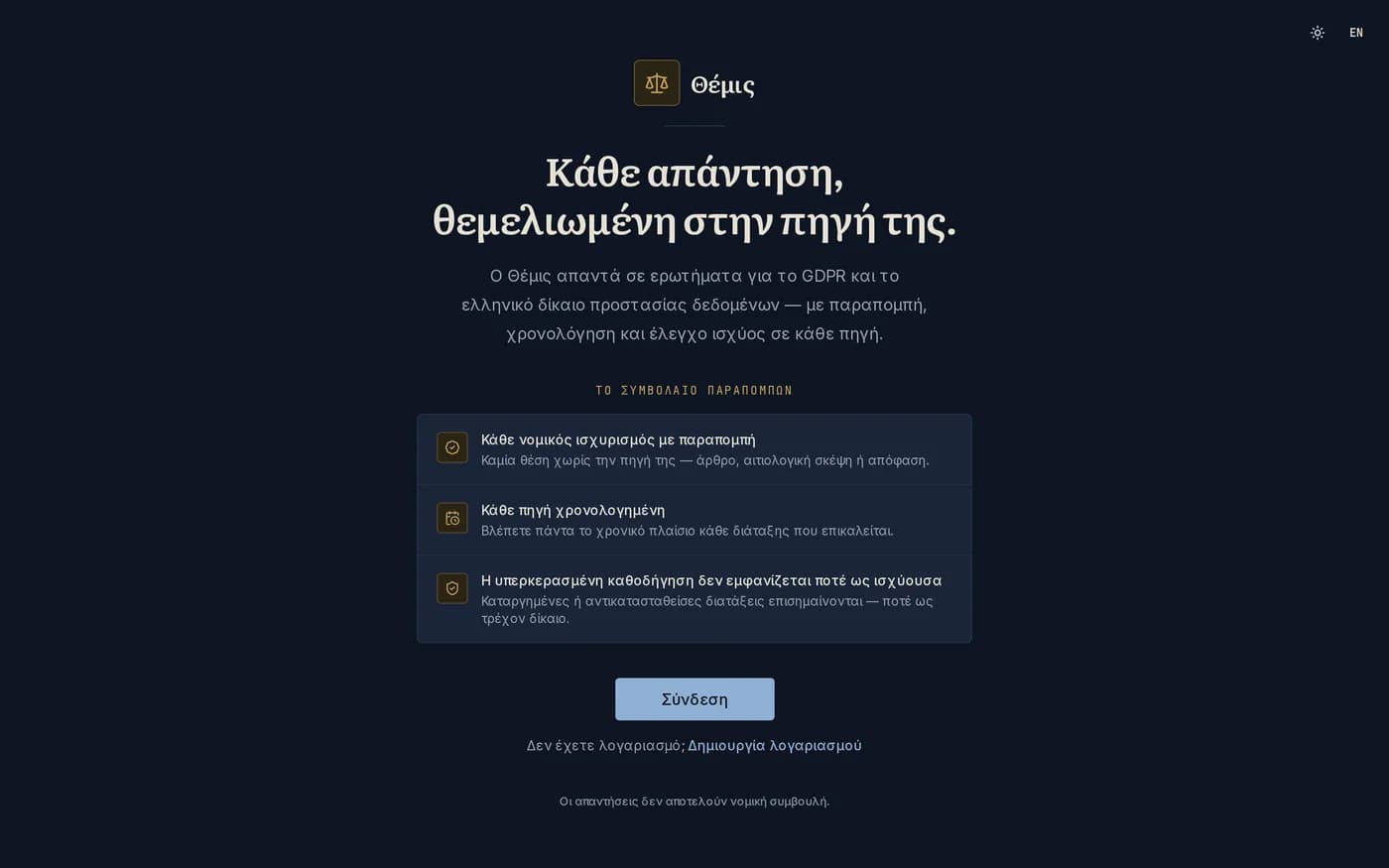
Every claim, with its source
This is the shape of an answer from a system we build: each claim on its own line, the document it comes from, how sure it is — and which retrieved sources it threw away. Point at a citation.
How long can we keep CCTV footage of our shop?
Answer
Only as long as you need it for the purpose you recorded it for.
High confidence
European guidance expects deletion within a few days in most cases, and treats about 72 hours as a sensible default.
High confidence
In Greece, the authority's CCTV directive caps retention at 15 days unless an incident is being investigated. It predates the GDPR, so confirm it for your case.
Check this one
Sources
1 · GDPR, Article 5(1)(e)
Personal data must be kept in a form that identifies people for no longer than necessary for its purpose.
2 · EDPB Guidelines 3/2019 on video devices
Footage should in most cases be erased after a few days; a longer period needs a specific justification.
3 · Hellenic DPA, Directive 1/2011
Recordings are kept for at most fifteen days, except where an incident is under investigation.
Retrieved, then judged irrelevant
GDPR Article 9, special categories — the question involves no biometric processing.
Illustrative, in the style of Themis, our GDPR assistant. Not legal advice.
What we actually build
Assistants over your own documents
Ask a question in plain language, get an answer with a citation next to every claim — and an honest "the documents don't say" when they don't. We've done this over 10M+ legal documents and over a 2,000-document regulatory corpus.
Enterprise legal platform · Themis
Agents that do work, with a human gate
Not a chatbot: a system that plans, calls real tools, and stops for approval before anything irreversible happens. A person reviews an editable plan and clicks yes — so automation never acts alone on something that matters.
Social Studio · AngelOS
Private inference on hardware you own
We spec the GPU box, compile the models, serve them, and route requests across instances so the GPUs reuse work they've already done. Nothing leaves your building and there is no per-token bill, which changes the economics entirely once volume is real.
Open source: TensorRT-LLM · vLLM · KV-cache routing
Evaluation, so you know it works
A test set of real questions with known-good answers, scored automatically on every change. Without it you're guessing, and quality degrades quietly as data and models drift. This is the step almost everyone skips.
Shipped with every AI engagement

Your data. Your choice.
On the frontier APIs
Claude, GPT or Gemini, wrapped in real engineering: caching, fallbacks, cost controls and an evaluation harness. The fastest route, with no hardware. Best when your data isn't sensitive and your volume is moderate.
Inside your own cloud
Your VPC, your Azure or AWS tenant, your compliance boundary. Open models served on GPUs you control. Best when data residency matters but you don't want to own hardware.
On hardware you own
We spec the GPU box, compile and serve the models, and hand you a private inference stack with routing, monitoring and cost dashboards. Nothing leaves the building, and there's no per-token bill. Best at high volume or under hard confidentiality.
Most projects end up at A. We'll say so if that's you — even though C is more interesting for us to build.
What we'll tell you for free
If a frontier API solves your problem, use a frontier API. Self-hosting is a cost decision, not a virtue.
If your documents are a mess, retrieval will be a mess. Fixing the data is usually cheaper than a bigger model.
If nobody can say what a good answer looks like, we can't measure it — and neither can you.
Greek-language retrieval is genuinely harder than English, and most tools handle it badly. We've spent real time on exactly that.
Have a problem that might be an AI problem?
Tell us in a sentence. We'll tell you honestly whether it is, and what the smallest useful first step looks like.